
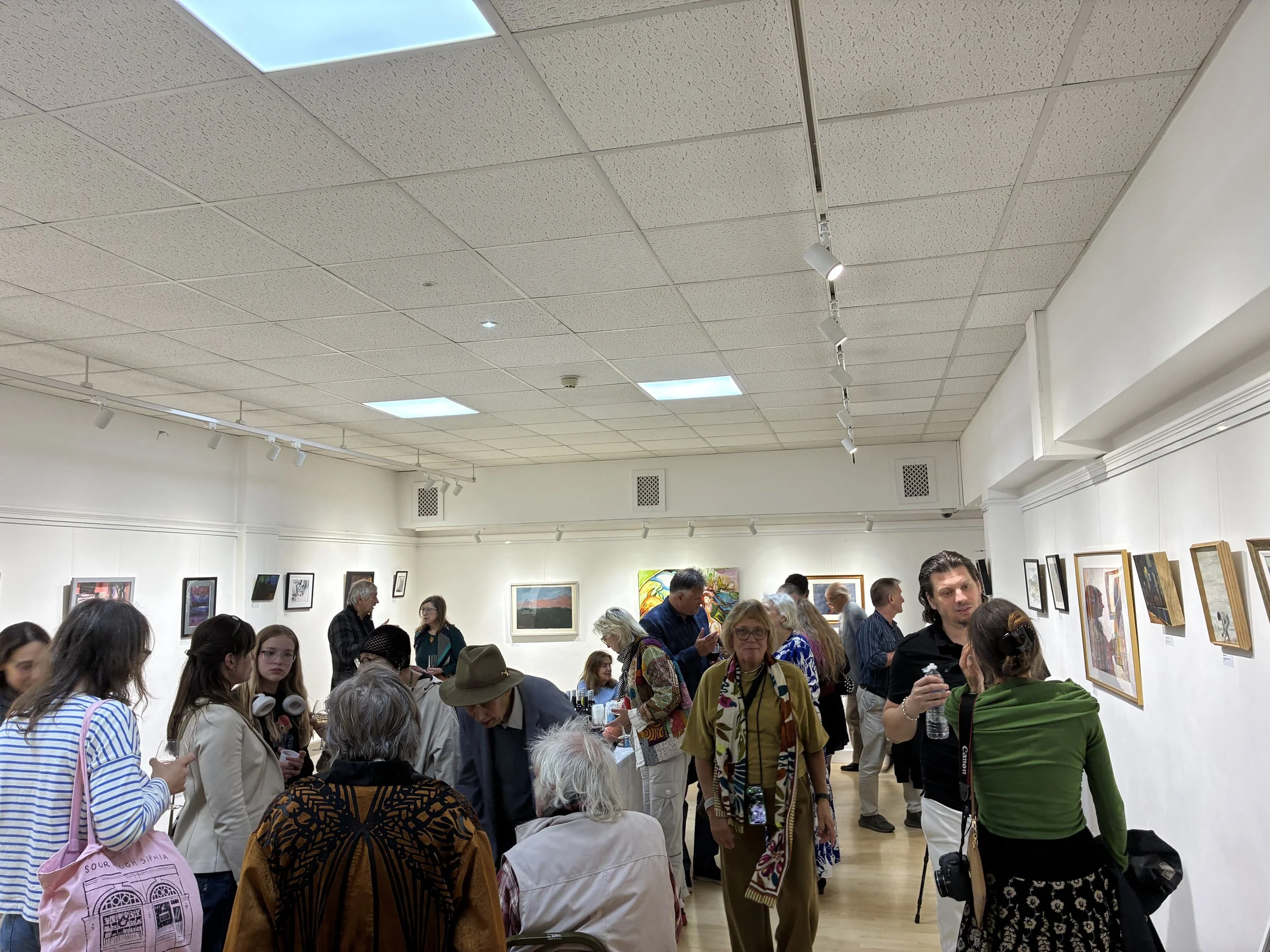
As I am writing this, it has been a day since the private view of APA’s Summer Exhibition 2026. Now that the dust has settled and I have been able to sleep it off, I can collect my curatorial thoughts and reflections for you, and help you understand what our thought process was.
Working with Jolanta Jagiello has been incredibly easy. Professional and open-minded, which is what I believe successful curation needs. My first approach to exhibiting and display is to understand that the space comes first, and the art should find the best way to blend with that space. Then it becomes about how each artwork speaks to the others: hidden semiotics, subtle symbols, and harmonious elements expressed through lines, colours, and forms.
This takes me to the first agenda: the topic of quantity, which has two tribes. One tribe believes that more is better; a celebration of art itself, creating the atmosphere of an art fair, often felt during open-call exhibitions. The other tribe, which I am part of, believes in quality over quantity, or, as my mum would say, “Co za dużo to nie zdrowo.” As much as I do not mind a good art fair, it is much harder to create a narrative with a wide range of artworks, especially in exhibitions without a theme.
So how does one create a narrative, a story, from a collection of artworks that are not connected by a theme? What about when there are fewer than thirty artworks? The answers are these: if you stare long enough at all the pieces, you begin to realise that many of them share subconscious similarities. After all, we all live in the same society. Regardless of class, we are all humans experiencing the world. In an age of globalisation, we are exposed to the same stories and the same news. Therefore, semiotics and symbolism provide a good starting point. They often manifest themselves through visual elements, as is the nature of the subconscious.
Let me give you an example through the display arrangements of the following works: Marek Emczek Olszewski’s Beyond II (Fig. 1), Jolanta Jagiello’s Gone Forever: Leaving a Black Hole (Fig. 2), Paweł Wąsek’s Clouds (Fig. 2), Maryla Podarewska-Jakubowski’s Burza (Fig. 3), and my Monk Ablaze Seeing Angles (Fig. 4).
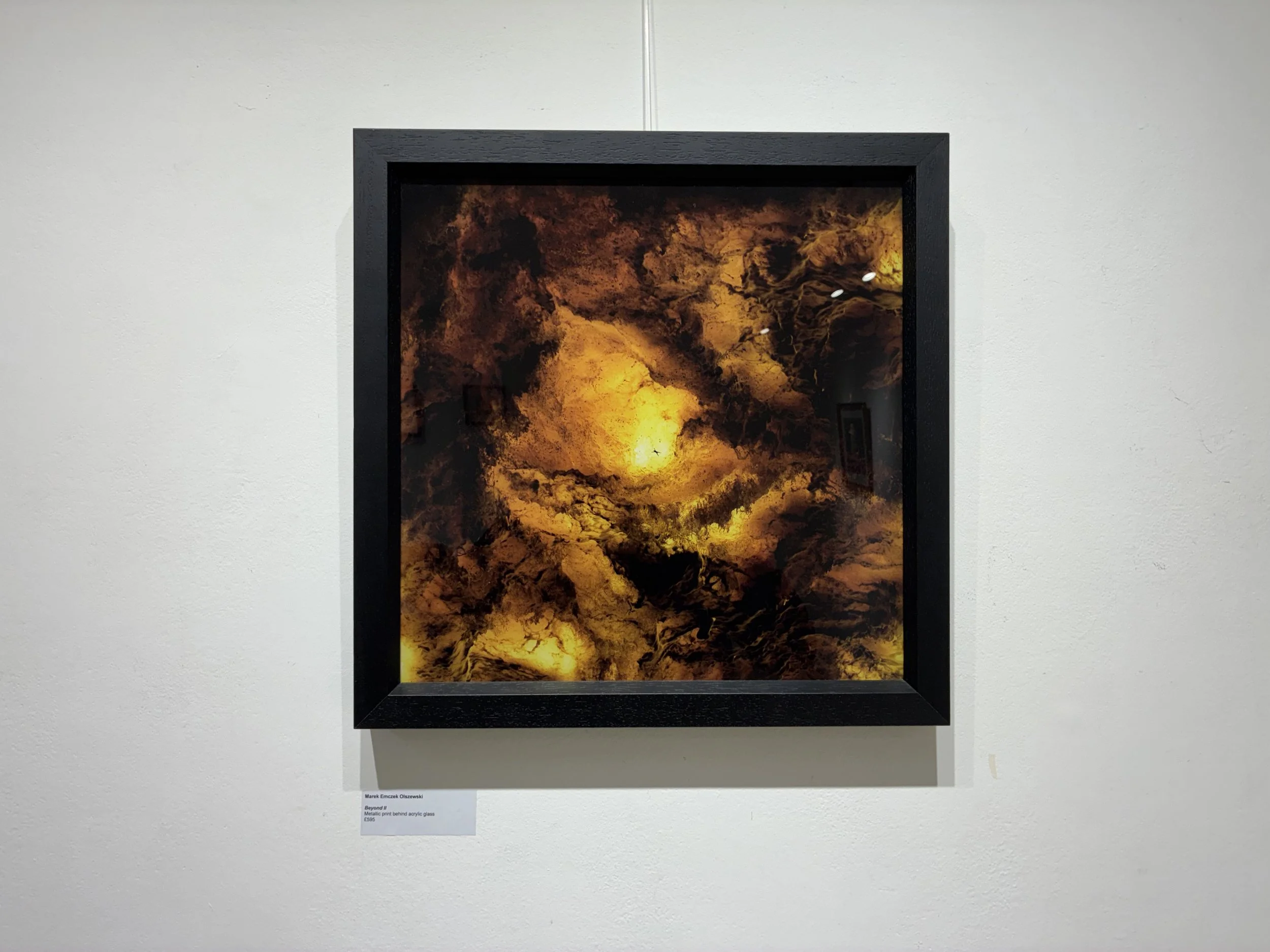
Marek Emczek Olszewski
Beyond II (Fig. 1)
Five artists who had not agreed on a theme, had not worked together, and in most cases had barely known one another, created works which together formed a dialogue around similar ideas. Beyond II kept making me think about falling into hell, carrying almost Dante-like connotations. Monk Ablaze Seeing Angles is about baptism through fire, deep faith, and the exploration of salvation. The angels that have recently appeared throughout my work make an appearance again, as the title suggests, which in turn made me think of Jagiello’s Black Hole both as a halo and as an abyss. This then circled back to Olszewski’s Beyond II.
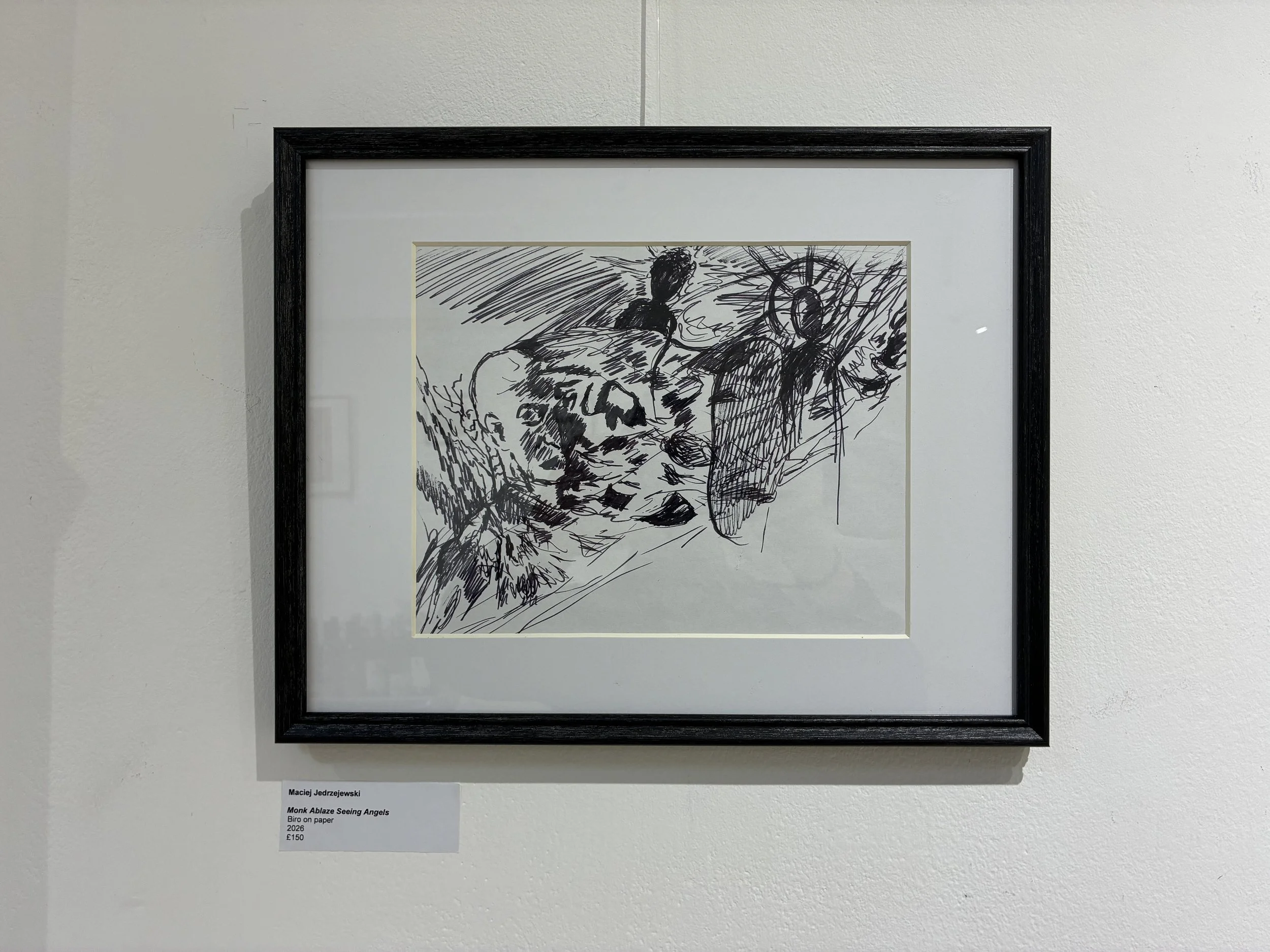
Maciej Jedrzejewski
Monk Ablaze Seeing Angles (Fig. 4)
At the end, like a cherry on top of a cake, Wąsek’s Clouds had to be hung above the Black Hole, above the halo. I call it the cherry on top because it was one of the last artworks whose placement I was unsure about. The two pieces beautifully supported one another, visually elevating each other. Podarewska-Jakubowski’s Burza also presented colours of the universe through its deep purples and the darkness associated with a true Polish storm — a burza. Even the mark-making within the painting carried the energy of a storm. Another piece drawing you into the abyss. Raw energy of lightning, wind, and fire. Semiotics interconnecting once again.
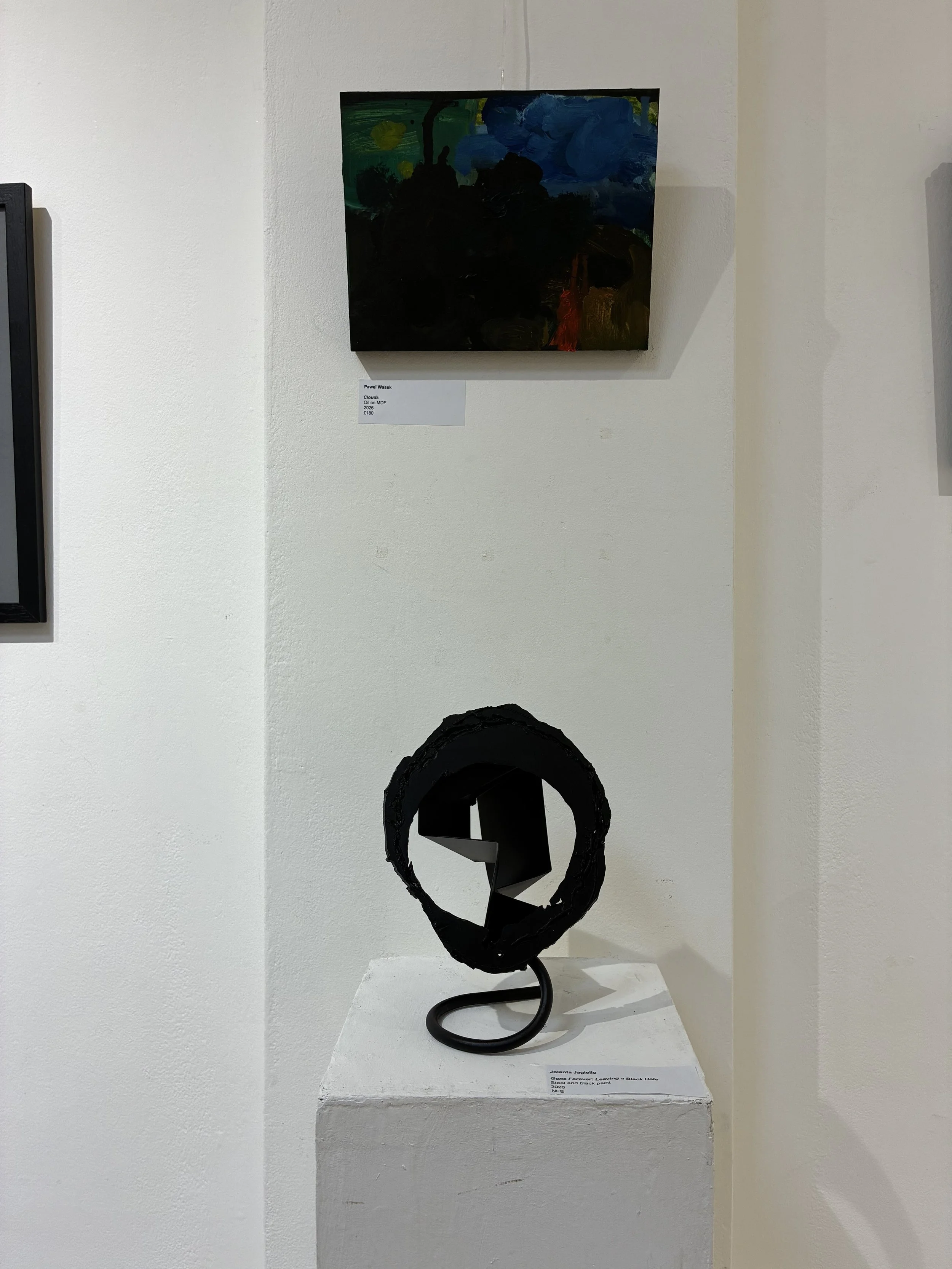
Paweł Wąsek
Clouds
(top)
Jolanta Jagiello
Gone Forever: Leaving a Black Hole
(bottom)
(Fig. 2)
This is how five artists formed a cross-shaped display, adding a spiritual and religious subliminal symbol that tied the whole arrangement together. It was Jolanta Jagiello’s suggestion from the very beginning to start grouping them together. Later, it became a matter of refinement for both of us, and I experienced a flood of visual and symbolic connections.
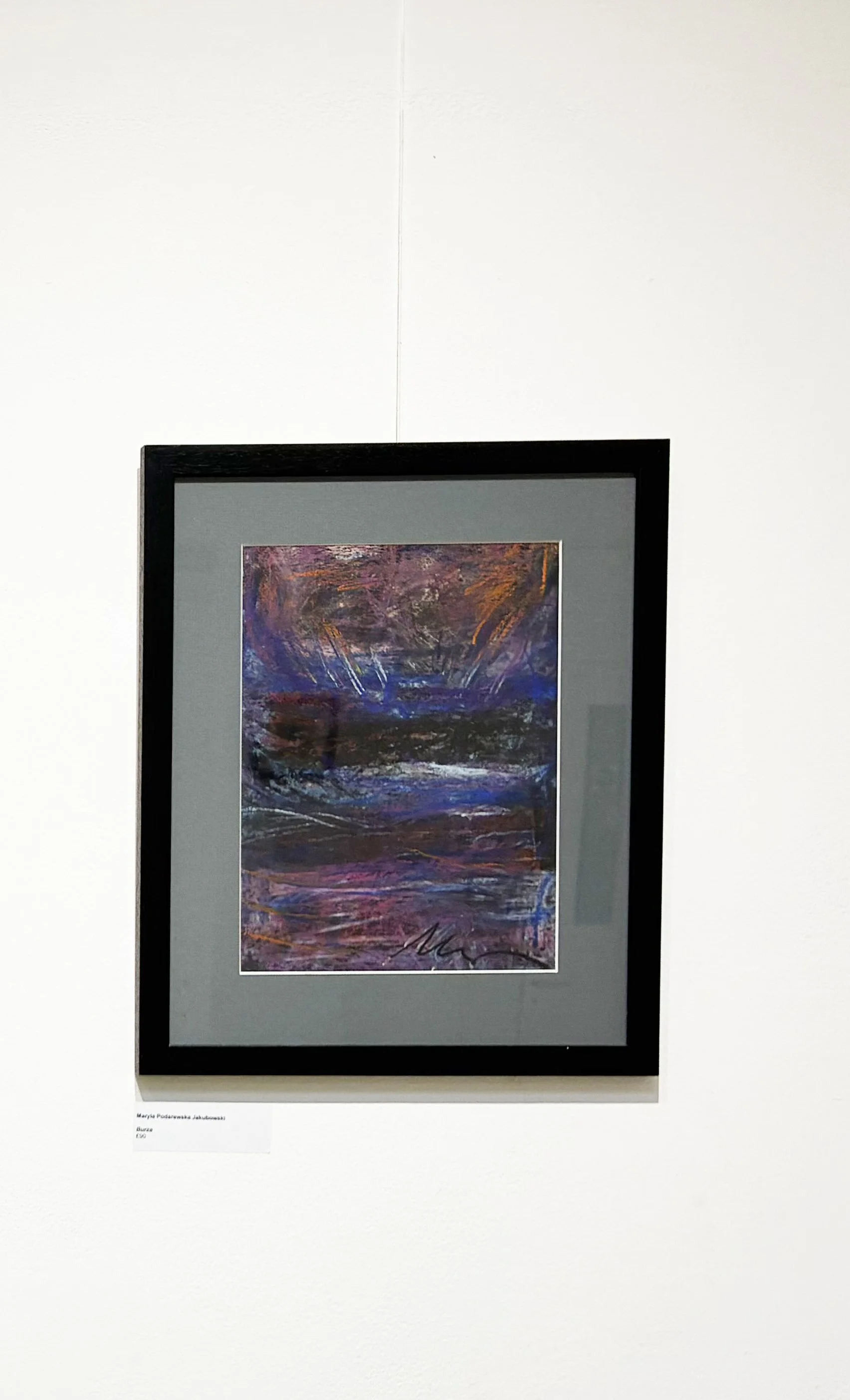
Maryla Podarewska-Jakubowski
Burza (Fig. 3)
Let us answer the second question now: what about when there are fewer than thirty artworks? This brings me to the second agenda, the matter of space.
As I mentioned at the beginning, space has to be respected. Out of respect, you should be attentive to it. You might argue that my underlying approach is influenced by Buddhism, which places importance on attentiveness and process. Asking the artworks, “What can I do for you to best show you off?” and extending the same kindness to the space: “How can I best bring out your beauty by decorating you with these artworks?” If a gallery is small, I am not going to overcrowd it, because then the artworks cannot have their own breathing space and be displayed in their full glory, which in turn attracts potential buyers.
To demonstrate my point of view, I am going to discuss the decisions behind the display of the following works: Teresa Chłapowski’s Step Inside & Unwind (Fig. 5), Joanna Ciechanowska’s Mr. Sunshine (Fig. 6), and Ruth Miemczyk’s As Long as an Echo (Fig. 7).
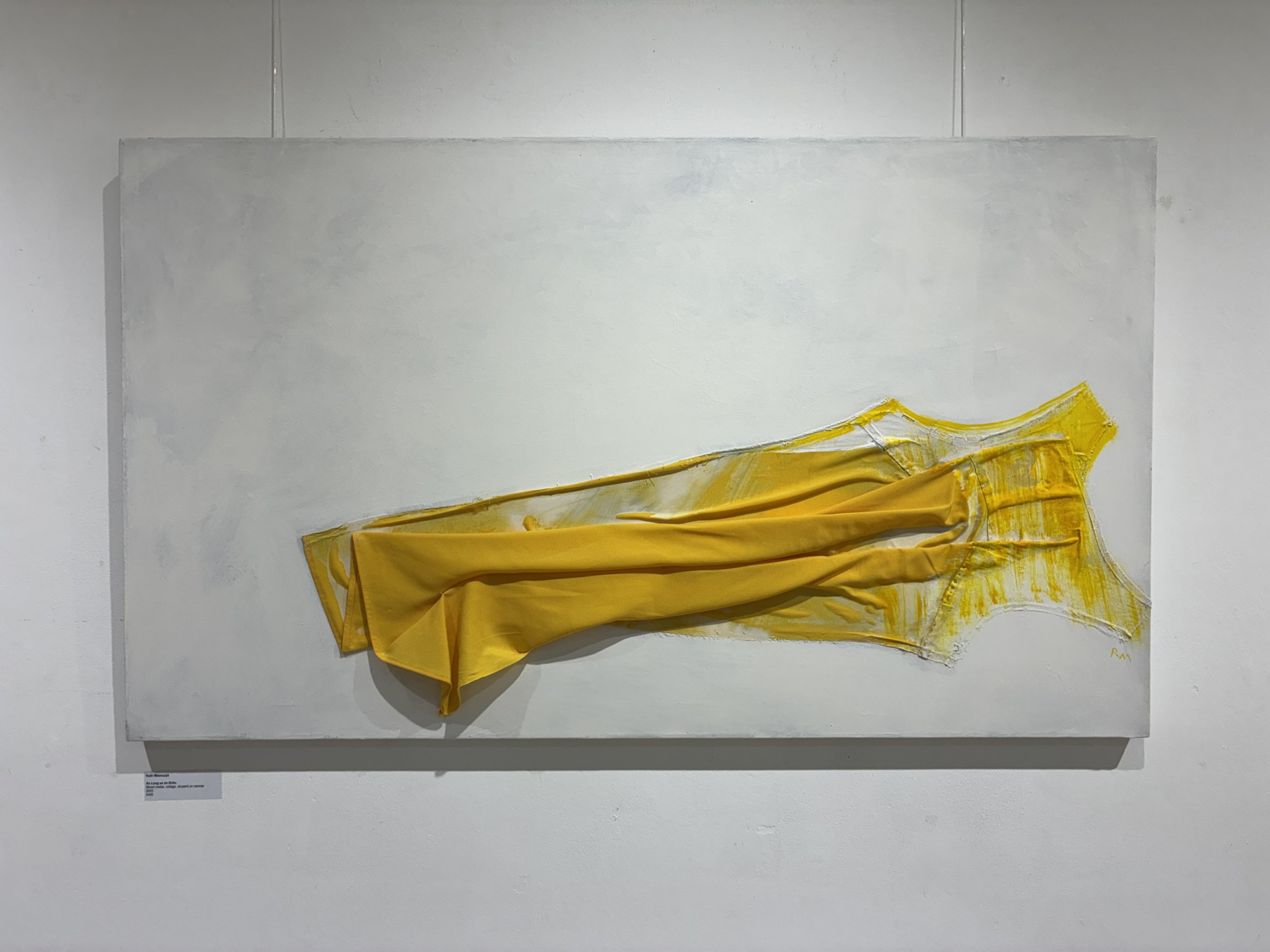
Ruth Miemczyk
As Long as an Echo (Fig. 7)
Here I want to thank Jolanta Jagiello for allowing me to make the bold decision to display Miemczyk’s As Long as an Echo by itself on the left-hand entrance wall. It is a large piece, measuring 120 × 70 cm. Given that POSK Gallery has a white-cube effect and is relatively compact, it felt like the best solution.
It is a visually striking piece because of its bold yellow element across a white background. I felt that visual impact needed to be contained. Unless I had two smaller works in a similar style by Miemczyk, I could not envision other pieces hanging beside it without distracting the viewer from its impact. It gives power to the work. It is not a matter of glorifying one piece because of personal taste; it is a matter of doing what is best for the work to be appreciated for its visual aesthetic. How can I best show you off? Sometimes that means making bold choices.
If the piece had been much smaller, would I still have hung it by itself on the entire first wall? Definitely not. It would not have had the same punch as you walk into the gallery. If there had been other pieces with stronger visual links to As Long as an Echo, would I have hung it on a different wall, or alongside other works? Potentially.
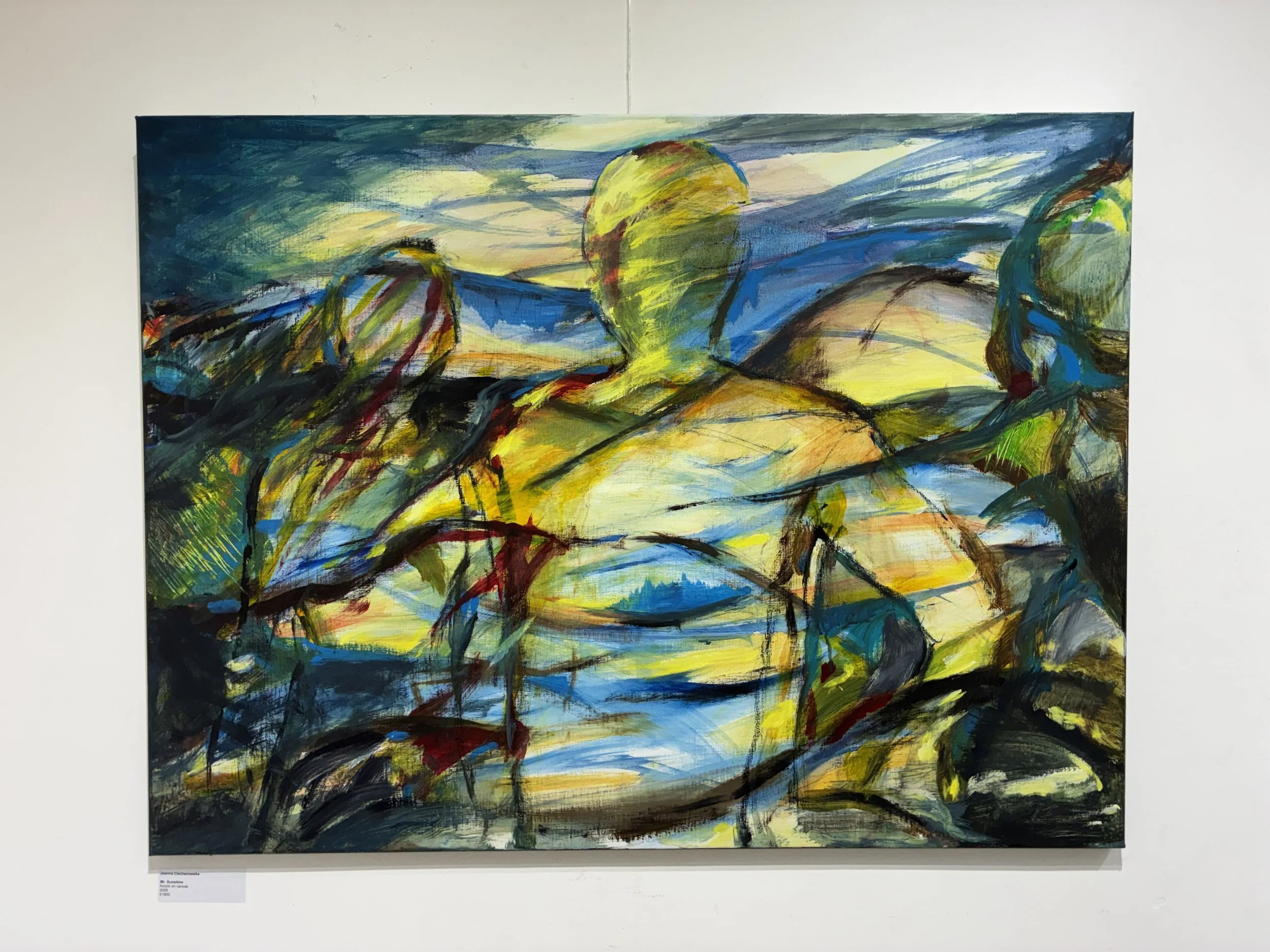
Joanna Ciechanowska
Mr. Sunshine (Fig. 6)
Mr. Sunshine by Ciechanowska is the first painting you see as you enter the gallery from the lobby (Fig. 6). Visitors are greeted by a visually striking work full of slashes and cuts, with yellows, reds, and blues. The yellow and the slashes provide the best possible continuation from Miemczyk’s piece. Within this semi-abstract painting are figures; the visitors are, in a sense, looking back at themselves.
They are then invited further into the gallery by Chłapowski’s Step Inside & Unwind (Fig. 5), displayed almost as an enchanted artefact. This perhaps explains why children at the opening described it as magical and were drawn towards it. It therefore made sense to place it directly opposite the entrance, encouraging visitors further inside.
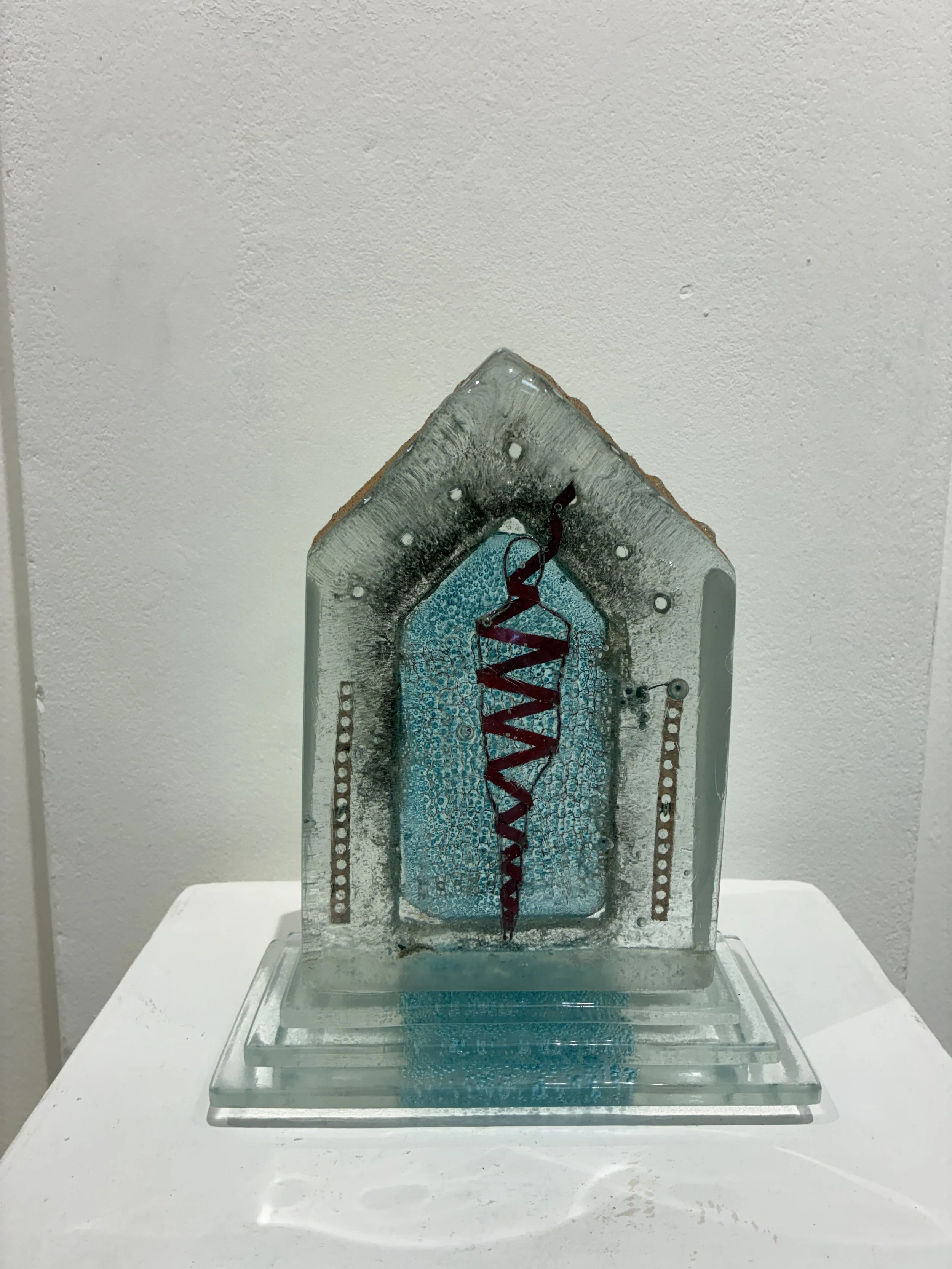
Teresa Chłapowski
Step Inside & Unwind (Fig. 5)
The glass gives the work a frozen, magical quality, with the copper contained within. The shape contributes to that feeling. The red zig-zag copper element strongly links with the red slashes in Mr. Sunshine, while the blues converse with the blues within Chłapowski’s piece. If you pay close attention, you might notice that the exhibition directs you from the whitest piece with one strong colour, yellow, through blues and gentle amounts of red, leading into greys and blacks, before gradually picking up colour again. This provides visitors with a gentle sensory build-up. Not having an overload of artworks allows more breathing space between them.
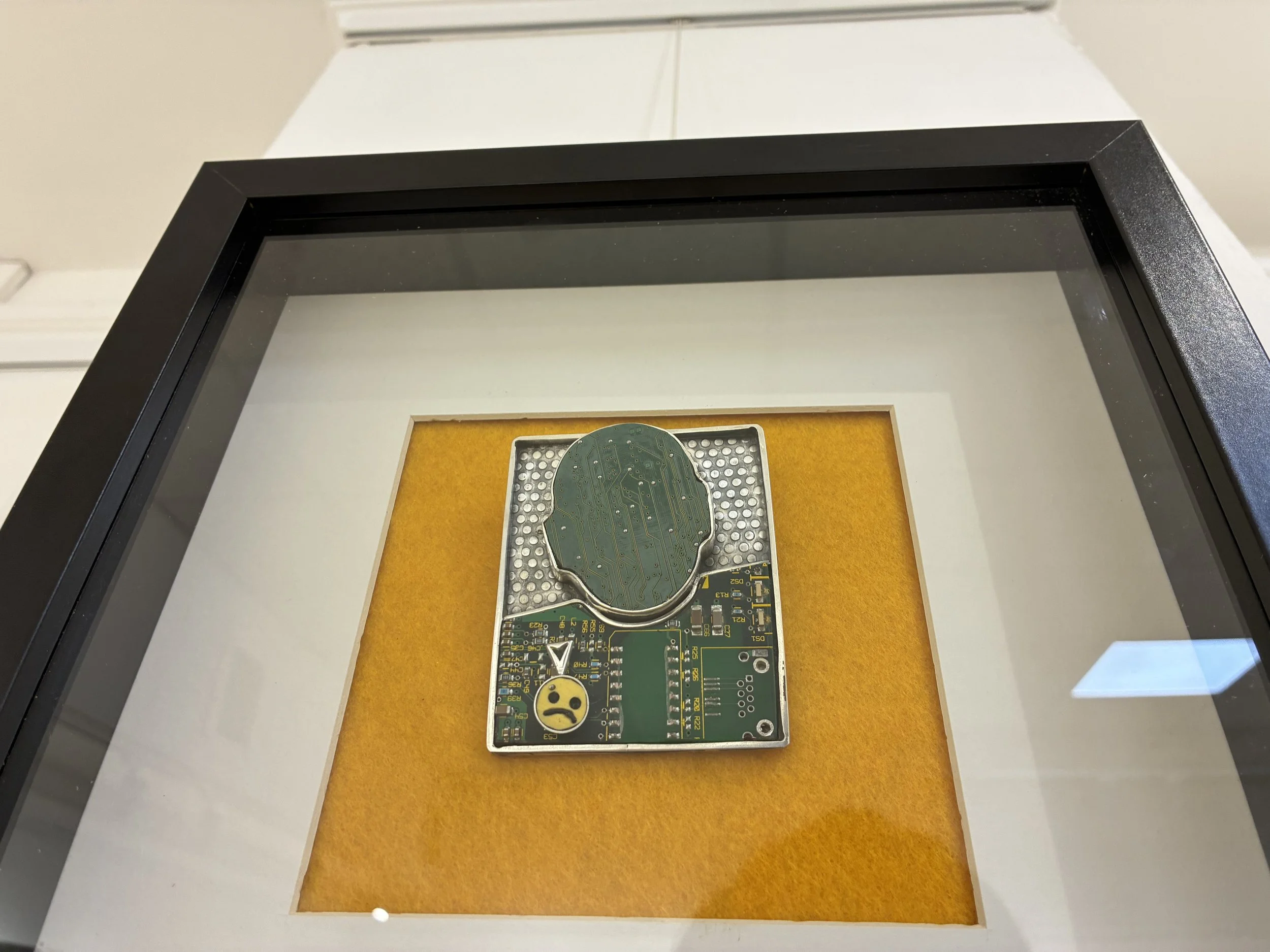
Andrzej Pacak’s The AI Decorated by the Last Human (Fig. 8)
Lastly, I would like to discuss Andrzej Pacak’s The AI Decorated by the Last Human (Fig. 8), a combination of sterling silver (925) and printed circuit board. It is a geometric portrait of a human measuring just 5.5 × 7 cm. Once you step closer, you begin to notice smaller details, such as the tiny frown-face badge the figure is wearing.
By repurposing a circuit board in this way, Pacak encourages us to appreciate its tiny intricacies, components, and complex structures. In the age of AI, when we are forced to evaluate our place within an ever-expanding digital world, the work becomes highly relevant and contemporary, inviting us to reflect more deeply on our relationship with artificial intelligence.
The placement that elevated this idea was on the gallery pillar containing the electrical unit. Pacak’s work, positioned directly above it, created the impression that the piece itself was plugged into the building's electrical system, strengthening the concept as a whole.
I could continue for quite some time discussing the thought processes behind the various choices Jolanta Jagiello and I made while curating the exhibition. However, having outlined my main points, I would conclude by saying that we received a broad range of styles and techniques. Overall, the quality was strong.
There were fewer sculptures than in previous years and a noticeable prevalence of darker colours, which is interesting in the context of a summer exhibition. Given the dark and rather depressing first two months of the year, however, this trend perhaps makes sense. On average, the works leaned more towards abstraction and semi-abstraction.
In the future, it could be interesting to see an exhibition dedicated to the younger side of APA, presenting what the future of the organisation has to offer. There is certainly space for a meaningful generational dialogue.
Disclaimer:
The artists listed below participated in APA Summer Exhibition 2026. Their names are presented in alphabetical order by first name for ease of reference. Any discussion of specific artworks within the review reflects the curatorial themes and examples selected for analysis and should not be interpreted as a ranking, preference, or assessment of artistic merit.
Agnieszka Laskus
Andrzej Pacak
Henryk Terpilowski
Joanna Ciechanowska
Jolanta Jagiello
Krystyna Dankiewicz
Lana Krupowicz
Louise Severyn-Kosinska
Maciej Jedrzejewski
Manka Dowling
Małgorzata Łapsa-Malawska
Marek Emczek Olszewski
Marek Jakubowski
Maria Kaleta
Margaret Laird
Maryla Podarewska Jakubowski
Monica Wheeler
Olga Sienko
Paweł Robert Jeliński
Paweł Wąsek
Pauline Rafal
Ruth Miemczyk
Teresa Chłapowski
Wojciech A. Sobczyński